
Extended Sizing Guide for Tall Men: XLT to 5XLT Explained
Extended sizing can be confusing, especially for tall men who need more than just a larger shirt size. While traditional sizes like XL, 2XL, and 3XL increase mainly in width, tall sizes such as XLT, 2XLT, 3XLT, 4XLT, and 5XLT are designed with additional length in the body and sleeves.
This guide explains how extended tall sizing works, the difference between regular and tall sizes, and how to choose the right XLT–5XLT size for jerseys, shirts, hoodies, and other big and tall apparel. Understanding these differences can help you avoid common fit problems like short sleeves, exposed waistlines, and jerseys that feel too short even when the width fits correctly.
Big & Tall Jersey Extended Size Chart (XLT–5XLT)
| Size | Chest Width (in) | Body Length (in) | Recommended Height | Notes |
|---|---|---|---|---|
| XLT | 48–50″ | 33–34″ | 5’11″–6’4″ | Extra length with athletic chest room |
| 2XLT | 52–54″ | 34–35″ | 6’0″–6’6″ | More torso length + wider shoulder span |
| 3XLT | 56–58″ | 35–36″ | 6’1″–6’7″ | Ideal for larger builds needing extra drape |
| 4XLT | 60–62″ | 36–37″ | 6’2″–6’8″ | Maximum shoulder width + extended tail length |
| 5XLT | 64–66″ | 37–38″ | 6’3″–6’9″ | Largest Big & Tall fit with full chest/waist room |
What Is the Difference Between Big and Tall Sizes?
One of the most common questions shoppers have is whether they need a Big size or a Tall size. While the names sound similar, they are designed to solve different fit problems. Understanding the difference can help you choose clothing that fits comfortably without simply guessing or ordering multiple sizes.
Big sizes are intended for people who need more room through the chest, shoulders, waist, and overall body. As the size increases from XL to 2XL, 3XL, 4XL, and beyond, the garment generally becomes wider to provide a more comfortable fit. However, the overall length of the shirt or jersey may only increase slightly. If your current clothing feels too tight across the chest or midsection, a Big size is often the right choice.
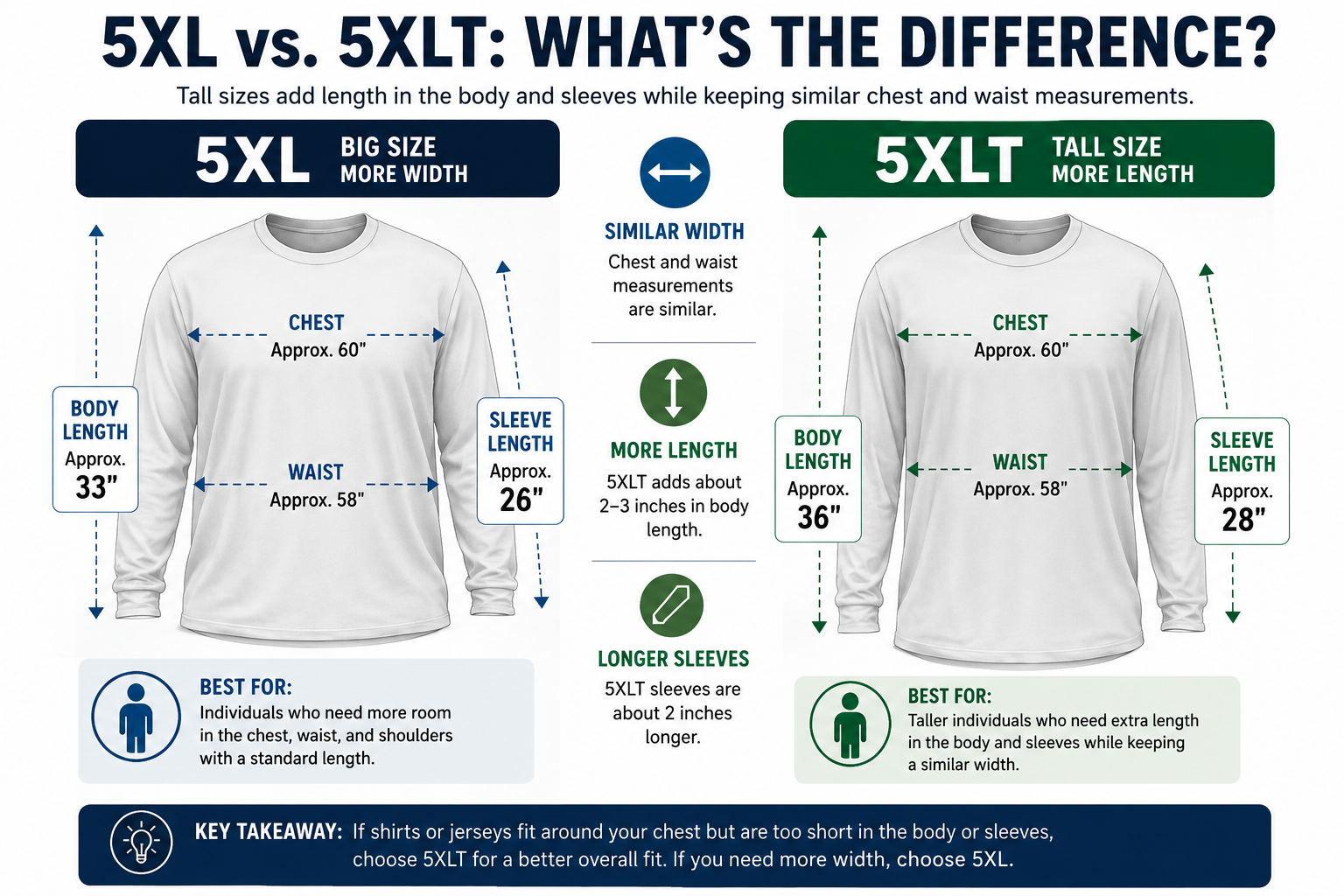
Tall sizes, identified with a T after the size (such as XLT, 2XLT, 3XLT, 4XLT, and 5XLT), are designed for people who need additional length rather than just additional width. Tall garments typically feature a longer torso, extended sleeves, and proportions that better suit taller frames. While the chest measurement is similar to the corresponding Big size, the added length helps prevent shirts and jerseys from riding up during everyday movement.
For example, someone who wears a 2XL because it fits well around the chest may still find that the sleeves are too short or the bottom of the jersey sits above the waist. In many cases, a 2XLT provides a better overall fit by adding length where it’s needed while maintaining a similar chest measurement.
Choosing a larger Big size isn’t always the best solution for a tall person. Moving from a 2XL to a 3XL may provide a little extra length, but it also adds more width than necessary. This can result in a loose or oversized fit that still doesn’t offer the sleeve or body length of a Tall size.
As a general rule, choose a Big size if you primarily need more width, and choose a Tall size if you need more length. If you need both additional width and extra length, extended Tall sizes such as 3XLT, 4XLT, and 5XLT are often the best option. These sizes are designed specifically for taller, larger builds and can provide a more balanced fit than simply sizing up.
Before buying any jersey, hoodie, or T-shirt, it’s also a good idea to compare the manufacturer’s sizing chart. Measurements can vary between brands, so checking chest, body length, and sleeve length can help you select the size that fits you best.
XLT vs. XL: Which Size Should You Choose?
Choosing between a regular size and a tall size isn’t always as simple as buying a larger shirt. Many people mistakenly size up from an XL to a 2XL or even 3XL when the real problem isn’t the width—it’s the length. Understanding how each size is designed can help you find a better fit without ending up with clothing that’s too loose.
An XL is designed for someone who needs a larger chest and waist measurement while maintaining standard body and sleeve lengths. It’s a good choice if your current clothing feels snug but the overall length is comfortable.
An XLT (Extra Large Tall) is designed for taller individuals who need additional length in the torso and sleeves while keeping a chest measurement similar to a regular XL. If your shirts or jerseys fit around the chest but seem too short when you sit down, raise your arms, or reach overhead, an XLT may provide a much better fit.
The same principle applies to larger sizes. A 2XL and 2XLT are similar in chest measurement, but the 2XLT includes extra body and sleeve length. Rather than sizing up to a 3XL just to gain a little more length, many taller men achieve a more balanced fit by choosing the corresponding Tall size instead.
Quick Fit Guide
| If this sounds like you… | Consider… |
|---|---|
| My shirt is too tight across the chest or stomach. | Size up to a larger Big size (2XL, 3XL, 4XL, etc.). |
| My shirt fits the chest but is too short. | Try the matching Tall size (XLT, 2XLT, 3XLT, etc.). |
| My sleeves are always too short. | Choose a Tall size. |
| I need more width and more length. | Look for 3XLT, 4XLT, or 5XLT depending on your measurements. |
The best way to choose between Big and Tall sizing is to compare your body measurements with the manufacturer’s size chart. Because measurements can vary between brands, checking chest, body length, and sleeve length before ordering can help you find the most comfortable fit and reduce the chances of needing an exchange.
Who Should Wear Tall Sizes?
That section can target people who are:
- 6’2″ and taller
- Long torso
- Long arms
- Shirts constantly ride up
- Hoodies don’t cover the waist
- Jerseys feel short when seated
More Sizing Chart Resource Pages That May Interest You :
Frequently Asked Extended Tall Sizing Questions
What does XLT mean in men’s clothing sizes?
XLT means Extra Large Tall. The “T” indicates that the garment is designed with extra length in the body and sleeves compared to a standard XL. Tall sizes are made for men who need more room vertically without simply sizing up in width.
What is the difference between XL and XLT?
The main difference between XL and XLT is the length. An XL provides additional width and overall room, while an XLT adds extra length through the torso and sleeves. Tall sizes are typically the better choice for men who find regular shirts ride up or sleeves feel too short.
How much longer is an XLT compared to XL?
Most XLT shirts and jerseys add approximately 2–3 inches of extra body length and additional sleeve length compared to standard XL sizes. Exact measurements vary by brand, so always check the manufacturer’s size chart before ordering.
What size comes after XLT?
Extended tall sizes usually progress like this:
XL → XLT → 2XLT → 3XLT → 4XLT → 5XLT
Each increase adds more room in the chest and waist while maintaining the extra-tall proportions.
Is 2XLT the same as XXL Tall?
Yes. 2XLT is another way of writing XXL Tall. The “2X” represents XXL sizing, while the “T” means the garment includes added length for taller men.
Who should wear a 3XLT, 4XLT, or 5XLT?
Men who need extended sizes such as 3XLT through 5XLT usually need both additional width and additional length. These sizes are designed for taller, larger builds where a standard 3XL, 4XL, or 5XL may fit around the body but still feel too short.
Are tall sizes only for tall men?
Not necessarily. Tall sizes are primarily designed for men who need extra length, usually those around 6’2″ and taller, but body proportions matter more than height alone. A shorter man with a long torso may prefer a tall size, while a very tall man with a shorter torso may not.
Do Nike, Adidas, and Fanatics make XLT and extended tall sizes?
Extended tall availability varies by brand and sport. Some manufacturers offer tall sizing in select jerseys, shirts, and apparel collections, while others focus mainly on standard big sizes. Always check the individual product measurements before purchasing.